Program Overview
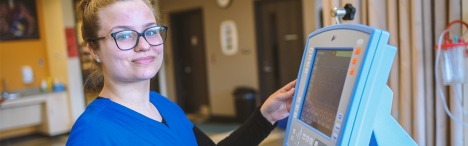
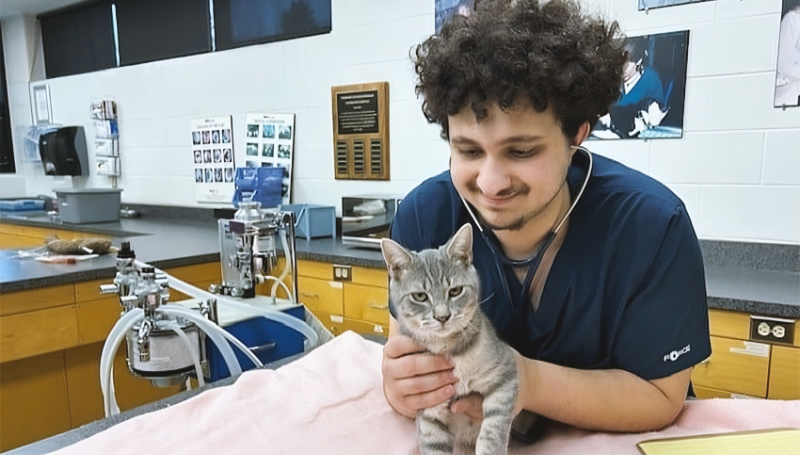
Veterinary Technicians assist the Veterinarian in the medical care of animals. Duties include radiography (taking x-rays), nursing, dentistry, nutritional support, surgical nursing and laboratory procedures for animals. This program will appeal to students with experience related to animals. They must have a strong background in science and math and good communication skills. Due to the physical demands of the job, they should also have the ability to lift and carry up to 25 kg.
Program Highlights
- Exceptional hands-on skills in the following species: Dogs, Cats, Rabbits, Birds, Rats, Mice, Horses, Cattle, and Sheep.
- Accredited by the Canadian Veterinary Medical Association.
- Teaching hospital accredited by the College of Veterinarians of Ontario.
- Facilities and animal use approved by the Canadian Council on Animal Care.
- Accredited by the Ontario Association of Veterinary Technicians.
- Work experience during semesters two and four.
- St. Clair College takes great pride in producing graduates who excel in their field. Students consistently demonstrate exceptional proficiency and achieve an outstanding 96% first-attempt pass rate on the North American Veterinary Technician National Exam (VTNE).
- Articulation Agreement with St. Matthews University in the Cayman Islands to become a veterinarian.
- The program has been in existence for over 50 years
Career Opportunities
Numerous positions exist in:
- Small and Large Animal Veterinary Clinics
- Livestock Health Facilities
- Wildlife Centres
- Pathology Clinics
- Zoological Parks
- Research Laboratory
- Entrepreneurship
- Animal Behaviourist
- Educator
- Practice Manager
- Humane Societies
- Pharmaceutical and Pet Food Industry
- Government (Animal Welfare Inspectors, Canadian Food Inspection Agency, Ontario Ministry of Agriculture, Food and Rural Affairs)
We invite you to explore www.rvtcareernavigator.ca to engage your passion and find your future in Veterinary medicine. Registered Veterinary Technologist/Technicians of Canada (RVTTC)
Admission Requirements
OSSD with the majority of courses at the College (C), University (U), University/College (M) or Open (O) level plus successful completion of:
- Grade 12 English - ENG4U, ENG4C, EAE4C or EAE4U
- Grade 12 Math (C) or (U)
- Senior Level Biology (C) or (U)
- Senior Level Chemistry (C) or (U)
OR
- Equivalent courses from the Pre-Health Sciences Pathway to Advanced Diplomas and Degrees program or the Academic and Career Entrance program.
Mature students - See Admission Procedures for details.
For more information, see the Admission Procedures document on the Admission Procedures page.
Important Information
This is a HIGH-INTEREST program and has the potential to become oversubscribed. Applicants are advised to apply before February 1st. See Admission Procedures for details.
Field/Clinical Placements
Clinical placements may be on day, afternoon or weekend shifts anywhere in Ontario. Students are required to provide their own transportation to the clinical area. The College is not able to guarantee placements in Windsor-Essex or on a bus route.
Selection Procedure
A score is determined for each applicant derived from the required subjects for admission. Scores are then ranked by highest score and selection is made for the available positions and places on the waiting list.
A score for a current high school applicant is determined for each applicant from the overall average of all Grade 11 courses and the first semester of Grade 12 courses. Applicants must be registered in all required courses in order to be considered.
Applicants will be ranked by highest score and selection will be made on a conditional basis for the available positions and places on the waiting list.
Recommended
Because of the unique nature of this program, it is recommended that before applying for the program you:
- Interview a Registered Veterinary Technician
- Obtain experience in a veterinary clinic
Health Requirements
Prophylactic rabies immunization is REQUIRED and should be arranged through your Family Physician, local Public Health office, or can be obtained at the College. The cost is approximately $1,100 and is usually recovered through most drug plans.
Courses
Please scroll to the bottom of the list to review the Pre/Co-Requisites.
The curriculum below is for incoming students:
Semester 1
| Code |
Title |
Credits |
|
VET112
|
Laboratory Procedures I
|
5
|
|
VET109
|
Veterinary Practice Management
|
2
|
|
VET116
|
Animal Anatomy And Physiology I
|
6
|
|
VET107
|
Introduction To Veterinary Technology
|
3
|
|
VET124
|
Veterinary Clinical Calculations
|
2
|
Semester 2
| Code |
Title |
Credits |
|
VET209
|
Introduction To Veterinary Radiography
|
2
|
|
VET216
|
Clinical Principles I
|
4
|
|
VET210
|
Animal Anatomy & Physiology II
|
5
|
|
VET212
|
Laboratory Procedures II
|
5
|
|
VET211
|
Veterinary Technician Pharmacology
|
2
|
|
VET214
|
Veterinary Technician Anesthesia
|
2
|
|
VET219
|
Veterinary Technician Placement
|
5
|
Semester 3
| Code |
Title |
Credits |
|
VET304
|
Clinical Principles II
|
3
|
|
VET307
|
Veterinary Clinical Radiography
|
2
|
|
VET310
|
Laboratory Procedures III
|
4
|
|
VET308
|
Veterinary Technician Dentistry
|
1
|
Semester 4
| Code |
Title |
Credits |
|
VET410
|
Laboratory Animal Care
|
3
|
|
VET414
|
Clinical Principles III
|
2
|
|
VET415
|
Laboratory Procedures IV
|
3
|
|
VET424
|
Clinical Exercises III
|
7
|
|
VET417
|
National Examination Review
|
1
|
|
VET431
|
Clinical Placement II
|
4
|
Past Cohorts:
Semester 1
| Code |
Title |
Credits |
| VET112 |
Laboratory Procedures I |
5 |
| VET115 |
Introduction To Veterinary Technology |
4 |
| VET116 |
Animal Anatomy And Physiology I |
6 |
| VET118 |
Veterinary Computer Applications |
1 |
| VET124 |
Veterinary Clinical Calculations |
2 |
| ELEC1030 |
Choose 1 Elective Course |
3 |
Semester 2
| Code |
Title |
Credits |
| VET209 |
Introduction To Veterinary Radiography |
2 |
| VET216 |
Clinical Principles I |
4 |
| VET210 |
Animal Anatomy & Physiology II |
5 |
| VET212 |
Laboratory Procedures II |
5 |
| VET223 |
Clinical Exercises I |
4 |
| VET211 |
Veterinary Technician Pharmacology |
2 |
| VET214 |
Veterinary Technician Anesthesia |
2 |
| VET219 |
Veterinary Technician Placement
(takes place the first 3 weeks of May) |
5 |
Semester 3
| Code |
Title |
Credits |
| VET304 |
Clinical Principles II |
3 |
| VET307 |
Veterinary Clinical Radiography |
2 |
| VET310 |
Laboratory Procedures III |
4 |
| VET309 |
Livestock Principles |
3 |
| VET327VT |
Clinical Exercises II |
8 |
| ELEC1030 |
Choose 1 Elective Course |
3 |
| VET308 |
Veterinary Technician Dentistry |
1 |
| VET311 |
Clinical Placement I |
4 |
Semester 4
| Code |
Title |
Credits |
| VET406 |
Externship |
5 |
| VET416 |
Exotic Pet Care |
2 |
| VET410 |
Laboratory Animal Care |
3 |
| VET414 |
Clinical Principles III |
2 |
| VET415 |
Laboratory Procedures IV |
3 |
| ELEC1030 |
Choose 1 Elective Course |
3 |
| VET424 |
Clinical Exercises III |
7 |
| VET417 |
National Examination Review |
1 |
| VET431 |
Clinical Placement II |
4 |
Placement Requirements
Prior to Classes
Entering Year 1 - Due September 5th, the start of the Fall Semester
Failure to provide proof of vaccination will limit your exposure to the colony animals, clinical exercises and your ability to participate in placement.
Our Veterinary Technician program provides extensive hands-on training in our accredited veterinary teaching hospital, where students learn and practice core clinical skills in a supervised environment. To further prepare students for professional practice, the program also offers extensive real-world clinical training through placements and externships in a variety of veterinary settings as part of our work-integrated learning.
Semester 2 Placement
After successfully completing all second-semester courses, students participate in a 2-week placement (80 hours) during the first two weeks of May at a small animal veterinary practice of their choice. During this experience, they work alongside a Registered Veterinary Technician (RVT) to apply and strengthen their clinical skills. Students also complete an online Fear Free certification as part of this placement. Students will be responsible for their own transportation and accommodations.
Semester 3 & 4 Clinical Placements
Students will select one veterinary practice each semester from a list of community veterinary hospitals, with a different clinic assigned each term. Clinics may be accessible by bus or may require personal transportation. The program coordinator will assist students who require bus-accessible placements; however, availability cannot be guaranteed. Throughout the semester, students will attend their assigned clinic for six shifts, each consisting of eight hours, scheduled during the week as part of their class rotation. In addition, students will complete a shift at the local Veterinary Emergency Hospital, either as one eight-hour shift on a weekend or two four-hour evening shifts during the week.
Semester 4 Externship
Halfway through the final (fourth) semester, students complete a two-week externship that provides further opportunity to explore different areas of the veterinary profession. Students may choose placements in small, large, or specialty veterinary hospitals, as well as research facilities, and may complete their externship anywhere in Canada or abroad. This experience allows students to refine their clinical skills while treating the externship as a valuable opportunity for career exploration and potential employment pathways. Students will be responsible for their own transportation and accommodations.
Your Investment
The standard tuition and compulsory fees for the current academic year:
Fall 2026 Tuition Fees
For programs with Experiential Learning (Work Placement/Internship): Costs for accommodation, if needed, travel and related expenses are at the student's own expense. It is recommended for most programs that students have access to a laptop or desktop computer while away from home during experiential learning periods.
Textbooks and other materials are in addition to Tuition Fees. Textbook prices may be found on the Bookstore website.
Tuition and Payment Info Campus Bookstore
Please be aware that tuition and compulsory fees are subject to adjustment each year. The College reserves the right to change, amend or alter fees as necessary without notice or prejudice.
Smart Start Information
Program Physical Demands Analysis
Program Vocational Learning Outcomes
Veterinary Technician (Ontario College Diploma) (MTCU Code 51603)
The successful completion of this program will enable the graduate to:
- Communicate in a professional manner with clients and veterinary care professionals using effective verbal, non-verbal and written skills.
- Assist the Veterinarian during surgical and therapeutic procedures by providing appropriate patient care techniques and through the maintenance of an aseptic operating room environment.
- Collect, process, report and analyze diagnostic tests on various specimens using appropriate tools, equipment and techniques.
- Produce and provide technical evaluation of diagnostic images utilizing knowledge of theory, principles and concepts of veterinary practice.
- Administer and monitor anesthesia, analgesia and therapeutics in accordance with the veterinary scope of practice and laws governing the profession.
- Perform dental procedures following professional veterinary industry standards.
- Perform veterinary nursing care in a professional and ethical manner through the integration of veterinary theory, principles and concepts within the scope of practice, regulations and governing laws of the profession.
- Document and maintain information records and files securely and accurately following veterinary office procedures and regulated standards.
- Operate and maintain standard veterinary medical equipment following health and safety regulations and in accordance with veterinary profession standards.
Additional Information
ACC Statement
The St. Clair College Veterinary Technician Program is accredited by the Canadian Council on Animal Care (CCAC). This organization oversees all animal use in Canada. Since St. Clair College is operating under the CCAC accreditation guidelines, we are required to have an Animal Care Committee (ACC). The ACC is mandated to monitor all animal-based activities on any St. Clair College campus.
The college is committed to the ethical and compliant care and use of animals in teaching and must follow all animal protocol guidelines under the Veterinary Technician Program Animal Care Committee. If anyone is aware of potential violations to existing animal care or observes misuse or mistreatment of animals, they are strongly encouraged to report their concerns without fear of reprisal. Please see Whistle Blower Report.