The Ontario Learn and Stay Grant (OLSG) provides funding for students enrolled in priority postsecondary programs in underserved and growing communities across Northern, Southwestern, and Eastern Ontario. The program supports students in high-demand fields, particularly health care, by encouraging graduates to remain and work in the region where they complete their studies.
Students who receive the OLSG must agree to a service commitment in the same service region where they studied after graduation.
What The Grant Can Cover
The Ontario Learn and Stay Grant may cover the full cost of eligible educational expenses, including:
- Tuition
- Compulsory fees
- Books
- Other direct educational costs (for example, required supplies or equipment)
Please note: The Ontario Learn and Stay Grant does not include coverage for the St. Clair College bus pass fee.
Applying for OLSG and OSAP
Students may apply for both the Ontario Learn and Stay Grant (OLSG) and OSAP. While OLSG covers many direct education-related costs, OSAP can help with other eligible expenses not covered by the grant, such as living and transportation costs.
For the most up-to-date program details, please visit: https://www.ontario.ca/page/ontario-learn-and-stay-grant.
Eligible St. Clair College Programs
The following St. Clair College programs are currently eligible for OLSG funding:
- BSCN/Collaborative Nursing (Chatham & Windsor)
- Registered Practical Nursing (Chatham & Windsor)
- Medical Laboratory Science (Windsor)
*Students who began one of the above programs after September 1, 2023, are eligible to apply for the OLSG.
Continuing Eligibility and Annual Applications
If you receive the Ontario Learn and Stay Grant in your first academic year, you must apply for the grant in each subsequent academic year in which you wish to continue receiving OLSG funding. OLSG is not automatically renewed.
If you decide not to continue receiving OLSG funding in a future academic year, you must contact the Financial Aid Office for further instructions. Choosing not to continue OLSG funding may affect your eligibility, service commitment requirements, or repayment obligations.
Students who wish to remain enrolled with their cohort but do not want to receive OLSG funding for a specific academic year may be eligible to request a Continuation of Interest Free Status (CIFS) related to their OLSG funding. This option allows students to maintain cohort progression without receiving OLSG funding and without incurring additional OLSG service commitment or workplace hours for that year.
Continuation of Interest Free Status requests are not automatic and are reviewed on an individual basis. Students must contact the Financial Aid Office before making this request to ensure they understand how opting out of OLSG funding may impact future eligibility and service requirements.
Service Commitment Requirements
To receive and retain the OLSG, students must agree to complete a service commitment after graduation.
As part of this agreement:
- You must work in the same service region where you studied
- You must complete at least 180 days (6 months) of work for every full year of study funded by the OLSG
St. Clair College is located in the Southwest Region, and service commitments must be completed within this region unless otherwise approved.
You will receive the full-Service Commitment Agreement when you apply for the grant.
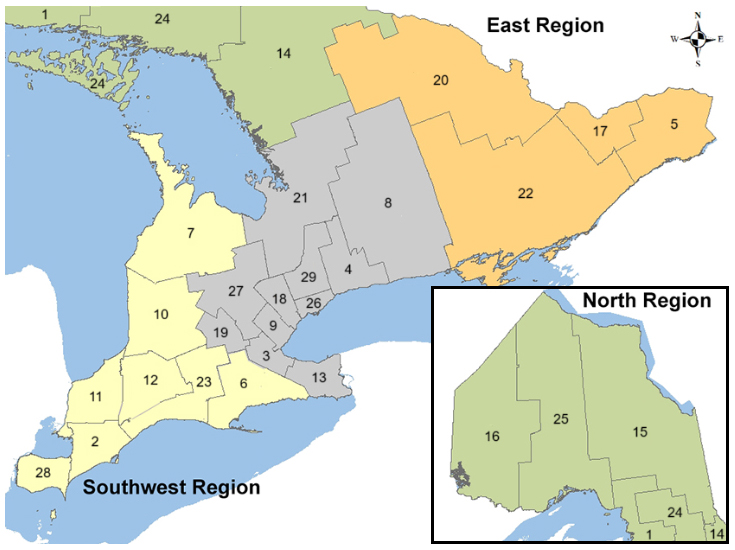
- Huron Perth/Oxford Elgin St. Thomas (10)
- Southwestern (23)
- Lambton (11)
- Middlesex-London (12)
- Chatham-Kent (2)
- Windsor-Essex County (28)
- Grey-Bruce (7)
- Grand Erie (6)
Cohort Deferrals, Interruptions, and Enrollment Changes
Changes to your academic status may affect your Ontario Learn and Stay Grant (OLSG) eligibility. This includes:
- Cohort deferrals
- Temporary leaves of absence
- Program interruptions
- Withdrawals or program changes
A cohort deferral occurs when a student formally requests to pause their studies with the intention of returning to the same program cohort at a later date. Cohort deferrals are not automatic, are reviewed on a case-by-case basis, and approval is not guaranteed. All cohort deferral requests must be initiated through the Financial Aid Office.
To retain cohort status, a cohort deferral request must be submitted within six (6) months of the end date of the academic term. Requests submitted outside of this timeframe may result in the loss of cohort status and could impact OLSG eligibility.
If you do not meet the required conditions of the OLSG, including completing your program or fulfilling the required service commitment, the grant may be converted to a repayable loan.
If you are considering any changes to your enrollment or academic timeline, you are strongly encouraged to contact the Financial Aid Office before making changes. Many situations are reviewed individually, and early guidance can help clarify available options and prevent unintended impacts on funding or repayment.
Important Reminders
- OLSG is conditional funding; eligibility depends on meeting both academic and service commitment requirements
- You must apply for OLSG each academic year you wish to receive funding
- Deferring, withdrawing, or changing programs without guidance may affect eligibility
- Not completing the required service commitment may result in the grant being converted into a loan
- Students may request a Continuation of Interest-Free Status to maintain cohort enrollment without receiving OLSG funding for a specific year
- Keep copies of all OLSG applications, agreements, and correspondence
- If you are unsure how OLSG applies to your situation, contact the Financial Aid Office as early as possible