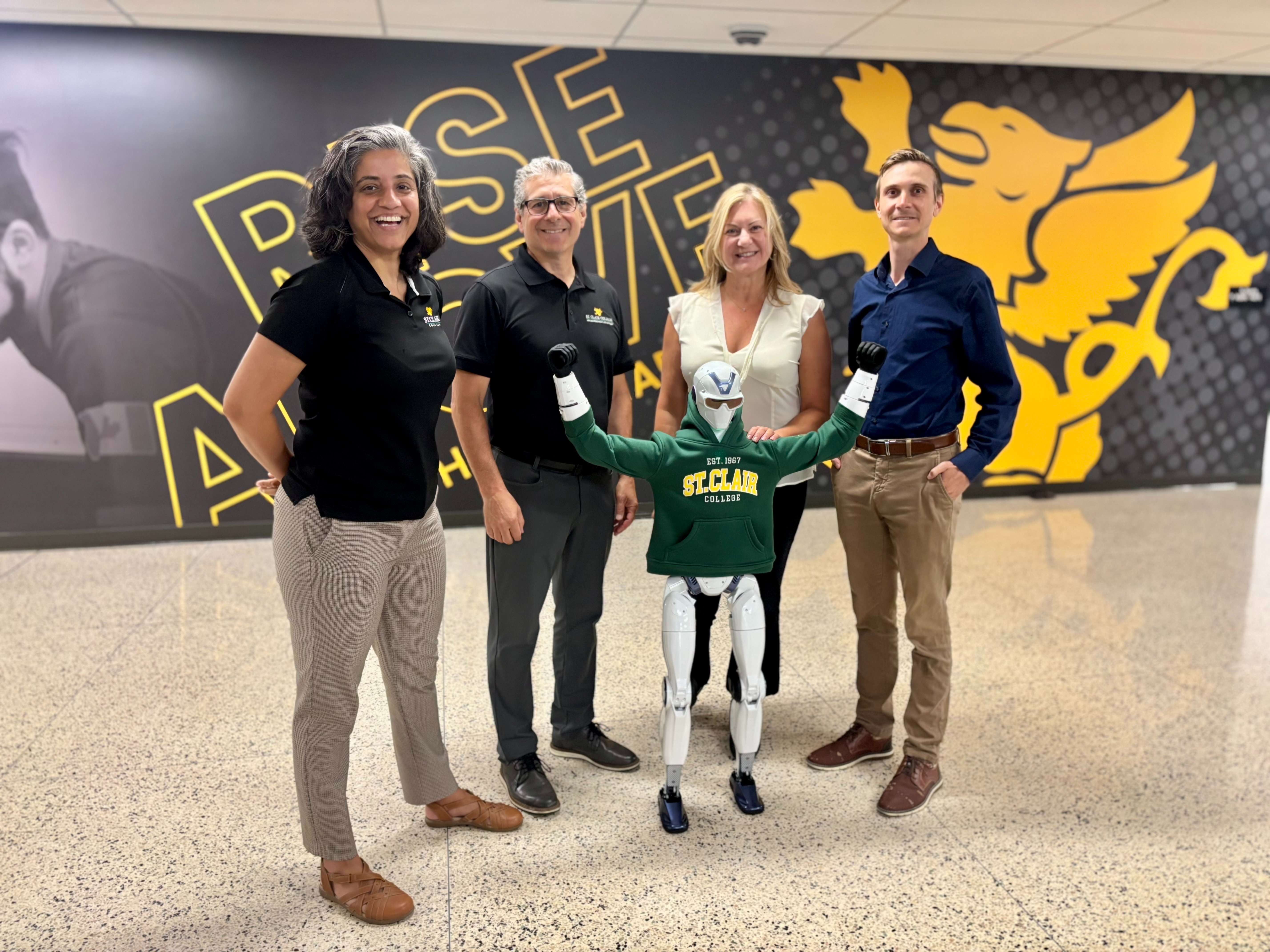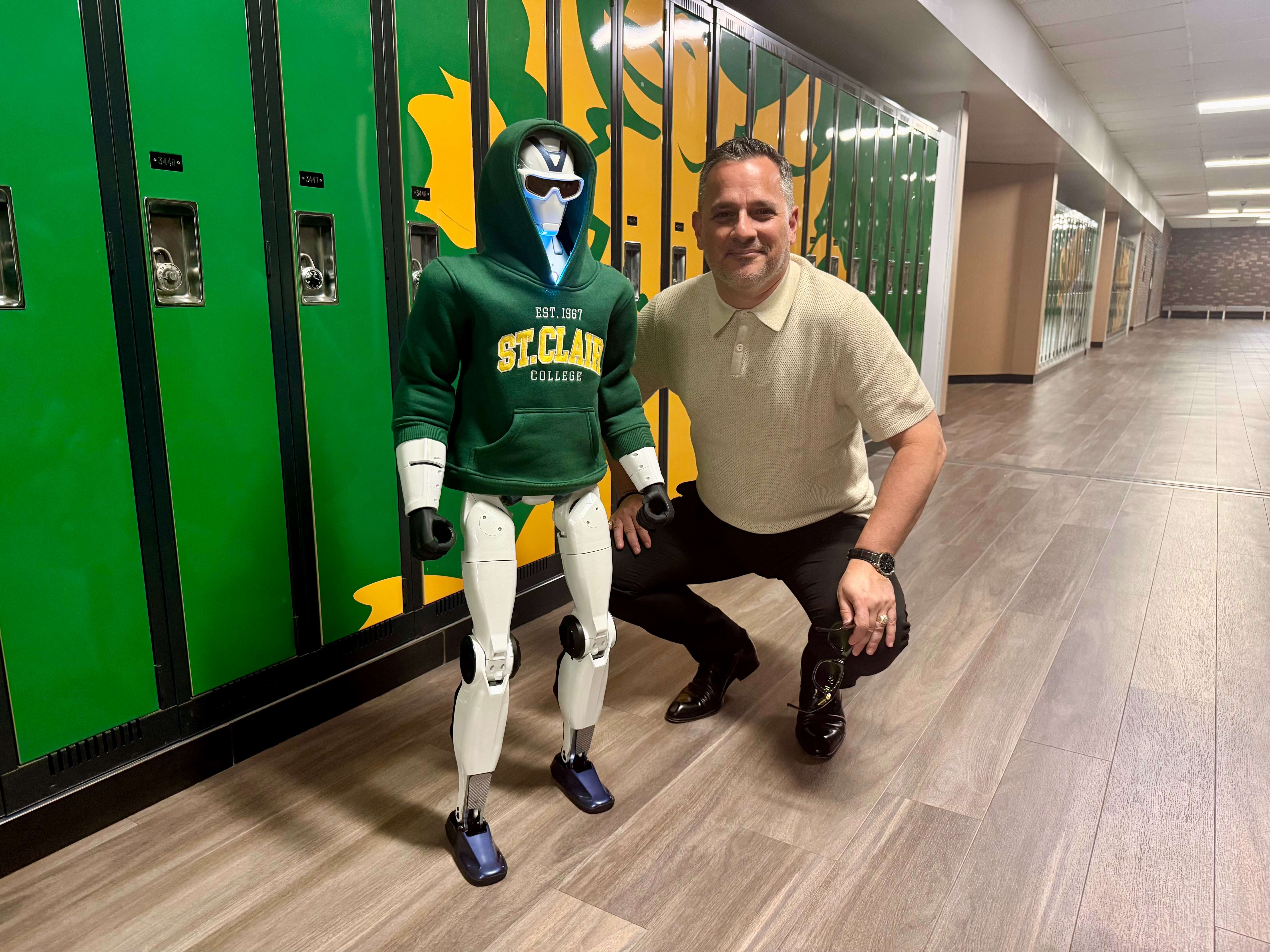
St. Clair College's newest arrival is already turning heads as they walk the corridors, learn their surroundings and begin their journey as a new kind of student.
St. Clair College is the first college in North America to receive the newly released Unitree R1 humanoid robot, which was delivered to the Research and Innovation department this week.
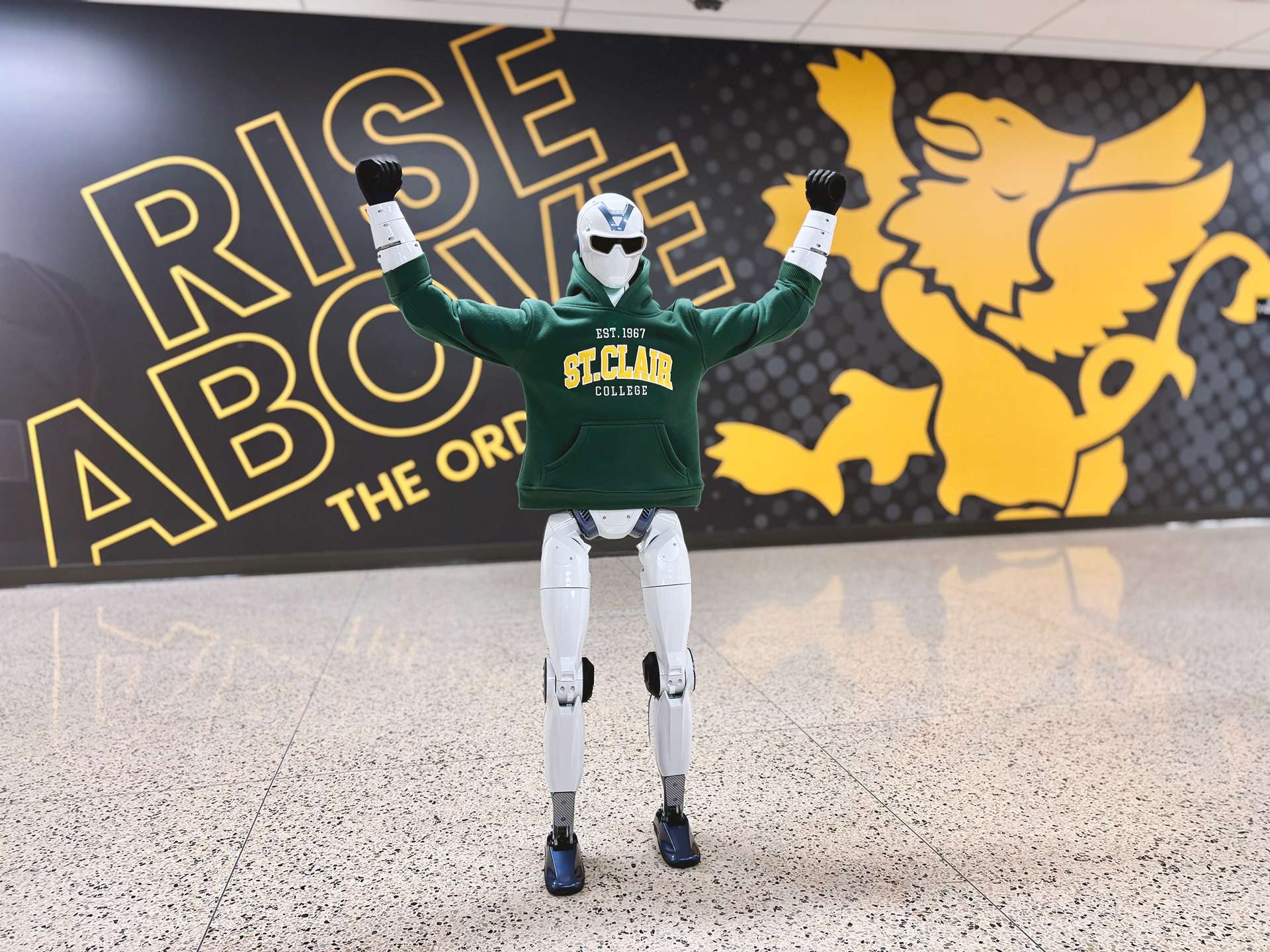
The robot can walk, run, talk and even dance – but the real potential lies in its ability to provide a powerful applied research platform for exploring how advanced robotics, artificial intelligence and large language models (LLMs) can improve industrial efficiency, productivity and operational decision-making.
"I think we all have come to realize that humanoids are coming. There's no denying that," said John Lopez, a Program Manager at St. Clair College's Research and Innovation department. "It's trying to get ahead of the curve and to understand what the capabilities are, how the software works, how the hardware works, how to incorporate AI and how to incorporate large language models into the humanoid so that we can be more efficient and also to help our industry partners."
The humanoid robot was purchased from InDro Robotics, a Canadian company, with funding from the Natural Sciences and Engineering Research Council of Canada (NSERC) through the Applied Research Tools and Instruments (ARTI) grant.
"The R1 is a next-generation, ultra-lightweight, and agile humanoid robot designed to make advanced robotics accessible for research, education, and early commercial applications," reads an excerpt on the InDro Robotics website. "It integrates an 8-core CPU, binocular vision, and a large multimodal language model for intelligent interaction and autonomous navigation, making it a highly programmable platform for exploring the future of embodied AI."
The robot weighs in at 29 kg and stands roughly four feet tall. It runs on battery power and can operate for about an hour on a charge.
"The potential is kind of unlimited," said Luke Corbeth, the head of R&D Sales for InDro Robotics. "Humanoids mimic the human form factor and what makes humanoids exciting is the world is built for humans, so if you have a robot with that kind of form factor, the infrastructure around it doesn't need to change."
"St. Clair College can definitely position yourselves as first movers here with this one," Corbeth added.I'm just really excited to see what you ultimately end up doing with it. With the right development and training, theoretically, they can be plugged and played into any environment and provide value and carry out tasks."
Working directly with industry, students and researchers will have the ability to test practical applications such as process monitoring, quality inspection, materials handling, workforce training, predictive maintenance, and the automation of repetitive or physically demanding tasks. The purpose is not simply to introduce new technology, but to work alongside industry partners to identify operational challenges, validate solutions and support responsible adoption within real workplace environments.
"In the age of digital education, funding agencies must invest directly in institutional research and innovation capacity," said Dr. Karamjeet K. Dhillon, the Director of Research and Innovation at St. Clair College. "This will give colleges the teams and flexibility to advance humanoid robotics, support industry operations and create more opportunities for students."
According to Dr. Dhillon, student participation with the humanoid robot is essential. By engaging in industry-led projects, St. Clair College students can gain direct experience with robotics, programming, data, artificial intelligence, cybersecurity, human-machine interaction and ethical technology deployment. These projects build the interdisciplinary skills employers increasingly require while allowing students to contribute meaningfully to the economic and technological advancement of the region.
"We want our students to be on the forefront of technology as well," said Lopez. "So if our students can get access to this humanoid, learn how to use it and how to manipulate it, they'll be right up there in their career searches ahead of most others."
Nick Dimitrov, an industrial technology advisor with the National Research Council of Canada (NRC), was at St. Clair College on July 21 to see the humanoid robot for himself.
"These humanoid robots are the forefront of research in application of AI in the physical world, and I think there are means where the LLM models and all the research in AI is going to touch our physical world, and we start delivering value," Dimitrov said. "I think we have to get involved with this technology as soon as possible, as Canada has challenges with productivity. I think these robots will help us bridge that gap, increase our productivity, and become more competitive."
Dimitrov says having the humanoid robot is a great way to introduce students to the new technologies available right now and for St. Clair College to reap the benefits of being first out of the gate.
"I think there's great opportunities for these humanoid robots to be in the greenhouses, be on the assembly line, handling parts," said Dimitrov. "You're in at the right time."
The R1 robot also creates an opportunity to examine how LLMs can be adapted to better reflect the communities they serve. This includes developing culturally responsive communication, recognizing diverse language patterns and perspectives, reducing bias, and involving community members in the design and evaluation of emerging technologies.
"By connecting technical innovation with cultural knowledge and lived experience, St. Clair College can help ensure that artificial intelligence is not only capable, but also inclusive, trusted and relevant," said Dr. Dhillon.
"Our goal is to work with industry and expose our students to cutting edge research."